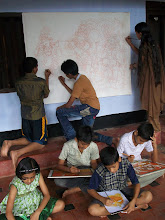
Mural art in India traces back to Ajanta and even earlier. In Kerala many of those traditions are still kept alive.Like Koodiyattom(Sanskrit Drama) for example.Whereas in rest of India these Classical art forms are extinct for lack popular support.
Mural Artists are trained to execute murals from the size of a (mughal) miniature, to end to end walls that span the sacred temples and public spaces.They are trained to execute murals in the classical tradition using natural dyes and pigments.
The mural 'Girija Kalayanam depicting the story of the wedding of Siva and Parvathi- a non-canonical version was done by Sasi Edavarad Gurukkal at a private residence in 2002 strictly adhering to traditional methods : (
http://www.facebook.com/photo.php?pid=30025169&l=e39a227d5b&id=1110180084)
Mural painting is in a period of transition where it is trying to reinvent itself on surfaces other than the sacred walls of temples.
All other pics you have seen on the facebook of artist Sasi Edavarad
Sasi Edavarad on Facebook
are in Acrylic both on wall( for example the 6 foot by 5 foot Manavedan completed in Dec2009)
and on canvas and paper.
Mahua Art Gallery had categorised Murals under the Folk art section
Ambalpoika: A swim in the Lily pond by Sasi Edavarad
and some think it is tribal art.
In fact, Mural painting is to art what Hindusthani sangeeth is to music.
It is deep and intense and needs an appreciation of what is called Classical Indian sense of beauty , aesthetics and poetics.


 Ettumanoor Vishnu
 Vastrapaharanam, Ettumanoor(left)
 Siva with Mayamohini,Kottakkal(left)
 Tali Calicut(below):
 < Pundareekapuram >
 From Panyannaru Kavu(left)